Grapedia Second Meeting
From Omics Data to Vineyard Impact
9 to 11 March 2027
Stellenbosch, South Africa
Grapedia II is an international symposium and workshop focused on how large-scale grapevine omics and functional datasets can be transformed into usable knowledge for cultivar improvement, vineyard performance, sustainability and climate adaptation.
Building on the first Grapedia symposium, this meeting will bring together researchers working across grapevine genomics, transcriptomics, epigenomics, metabolomics, phenomics, genetics, functional genomics, gene characterisation, systems biology, bioinformatics, data science, and viticulture. The focus is not only on generating new datasets, but on making these datasets structured, interoperable, interpretable, and useful through community resources such as Grapedia.
Recent advances in grapevine research have generated high-quality reference genomes, pangenomes, graph-based genomic resources, transcriptomic and epigenomic datasets, single-cell approaches, phenotyping and phenomics datasets, population-scale datasets, functional gene studies, and tools for data exploration. Grapedia II will explore how these resources can be integrated and used to generate biological insight and support practical outcomes in cultivar and vineyard improvement. Across three themed days, the symposium will move from data generation and community resources, to biological interpretation and tool-driven analysis, and finally to cultivar and vineyard impact.
Location
Grapedia II will be held in Stellenbosch, South Africa over three days from 9th to 11th March 2027. Stellenbosch provides an ideal setting for Grapedia II, combining world-class academic infrastructure with the cultural and agricultural landscape of one of the Southern Hemisphere’s most important wine regions. The symposium will be hosted at the Stellenbosch Institute for Advanced Study (STIAS), a venue designed to support focused discussion, interdisciplinary exchange, and international research collaboration.
Address: Stellenbosch Institute for Advanced Study (STIAS), Wallenberg Research Centre, 10 Marais Road, Mostertsdrift, Stellenbosch. South Africa
Invited Keynote Speakers
Jędrzej Jakub (JJ) Szymanski, IPK (Germany)
Systems integration and multi-omics interpretation
Alain Goossens, (VIB-UGent, Belgium)
functional genomics and specialised metabolism
Dario Cantu, UC Davis (USA)
pangenomics, graph genomes, epigenomics, transcriptomics, GWAS, and single-cell approaches
Camille Rustenholz, INRAE Colmar, Univ. Strasburg (France)
grapevine omics resources and structured datasets
Yongfeng Zhou (Chinese Academy of Agricultural Sciences, China)
David Navarro-Payà, I2SysBio (Spain)
Plantae (Vitviz) related tools for exploring omics data, genome annotation pipelines
Conference Themes
Meeting Aim
Grapedia II is designed as a highly interactive, discussion-oriented meeting. Its goal is to help the grapevine research community move from data accumulation to data use, by making omics and functional resources for grapevine more accessible, interpretable, and impactful. This approach and philosophy will support cultivar innovation, sustainable viticulture and improved vineyard performance.
Day 1 — Data as a Community Resource
Building the data foundations for next-generation grapevine improvement
Day 1 focuses on Grapedia as a community platform and on the generation, structuring, and sharing of grapevine datasets. Topics include reference genomes, pangenomes, graph-based approaches, transcriptomic and epigenomic datasets, single-cell data, phenotyping resources, and structured functional datasets. The day will highlight how diverse data types can be made reusable, interoperable, and accessible for the wider grapevine community.
Discussion topic: What makes grapevine datasets reusable and interoperable?
Day 2 — From Data to Biological Insight
Turning data into actionable knowledge for trait and cultivar development
Day 2 focuses on how omics, phenomics, and functional datasets can be integrated and interpreted to generate biological understanding. Topics include systems integration, functional genomics, gene characterisation, pathway analysis, trait biology, and tools for exploring and visualising complex datasets. The emphasis is on moving from data and candidate genes to biological mechanism and testable hypotheses.
Discussion topic: How do we move from data-rich to knowledge-rich grapevine biology?
Day 3 — From Knowledge to Cultivar and Vineyard Impact
Applying omic knowledge to improve cultivars and vineyard performance
Day 3 focuses on the application of omic and trait knowledge to cultivar development, vineyard resilience, sustainability, and long-term adaptation to changing production environments. Topics include grapevine diversity, population genomics, trait-associated variation, rootstocks, adaptation, phenotypic performance, and the translation of biological insight into practical outcomes for breeding and vineyard management.
Discussion topic: A roadmap for data-driven cultivar and viticultural improvement in grapevine

Programme
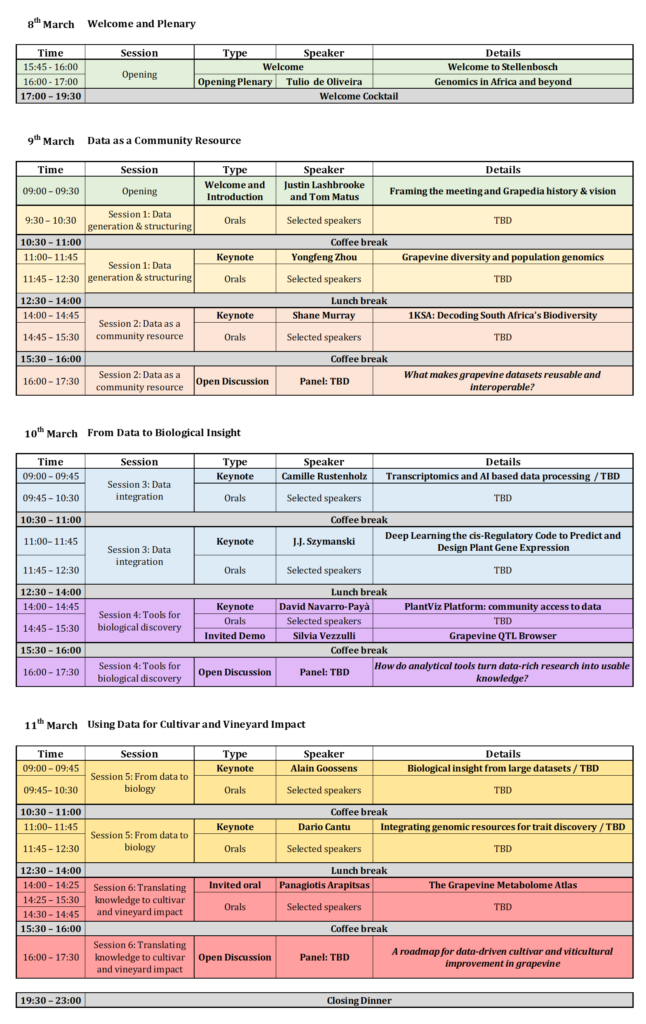
Day 1 — Data as a Community Resource
Time | Session |
08:00 – 9:00 | Registration |
09:00 – 10:30 | Session 1: Welcome by GRAPEDIA Chair (J. Tomás Matus) |
10:30 – 11:00 | Coffee break |
11:00 – 12:30 | Session 2 |
12:30 – 14:00 | Lunch |
14:00 – 15:30 | Session 3 |
15:30 – 16:00 | Coffee break |
16:00 – 17:30 | Discussion: What makes grapevine datasets reusable and interoperable? |
17:30 – 19:30 | Welcome cocktail |
Day 2 — From Data to Biological Insight
Time | Session |
09:00 – 10:30 | Session 4 |
10:30 – 11:00 | Coffee break |
11:00 – 12:30 | Session 5 |
12:30 – 14:00 | Lunch |
14:00 – 15:30 | Session 6 |
15:30 – 16:00 | Coffee break |
16:00 – 17:30 | Discussion: How do we move from data-rich to knowledge-rich grapevine biology? |
Day 3 — From Knowledge to Cultivar and Vineyard Impact
Time | Session |
09:00 – 10:30 | Session 7 |
10:30 – 11:00 | Coffee break |
11:00 – 12:30 | Session 8 |
12:30 – 14:00 | Lunch |
14:00 – 15:30 | Session 9 |
15:30 – 16:00 | Coffee break |
16:00 – 17:30 | Discussion: A roadmap for data-driven cultivar and viticultural improvement in grapevine |

19:00 – 23:00 | Closing dinner |
Local Organising Committee
Justin Lashbrooke
Department of Genetics
Stellenbosch University
Chair of local organising committee
Manuela Campa
Department of Genetics
Stellenbosch University
Johan Burger
Department of Genetics
Stellenbosch University
Marike Visser
School for Data Science and Computational Thinking
Stellenbosch University
Presentation Formats
The programme will include several presentation formats to encourage both scientific depth and practical data exploration:
- Keynote lectures — 45 minutes, including discussion
- Oral presentations — 15 minutes, including questions
- Tool demonstrations — 25 minutes, presenting existing or emerging tools, platforms, datasets, or workflows with an emphasis on practical use and interaction
- Flash talks — 5 minutes, designed for concise presentation of ideas, datasets, tools, or early-stage work, no questions
- Mini Flash – 3 minutes, designed as a short alternative to poster presentations
The Tool Demonstration format is a central feature of the meeting, highlighting how grapevine datasets can be explored and reused through practical interfaces, analytical platforms, and community resources, and we encourage submission for this format.
Discussions and Community Output
One of the goals of Grapedia II is to produce a community-authored perspective manuscript provisionally titled:
A roadmap for data-driven cultivar and viticultural improvement in grapevine

The manuscript will synthesise outcomes from keynote presentations, tool demonstrations, and importantly the structured discussion sessions. The discussion sessions will occur each day and all attendees will be invited to contribute. Recordings and transcripts from the meeting will be used to support synthesis and drafting, with authorship determined according to contribution and journal guidelines.
Registration and Abstracts
The meeting is expected to host approximately 60–90 participants, including keynote speakers, researchers, postgraduate students, and industry stakeholders.
Registration fees
Category | Early Bird (until November 27th) | Standard (until February 19th) |
Student registration | € 225 | € 275 |
Academic registration | € 395 | € 500 |
Industry registration | € 695 | € 800 |
Registration includes access to all symposium sessions, keynote lectures, tool demonstrations, discussion sessions, lunches, tea/coffee breaks, the Day 1 welcome cocktail, and the Day 3 closing dinner.
Abstract formats
Abstract submitters will be able to indicate their preferred presentation format
- Oral presentation
- Tool demonstration
- Flash talk
- Mini flash
Abstract themes
Submissions are welcomed across a broad range of data-driven and functional grapevine research. Abstract submitters may select up to three themes:
- Genomics, epigenomics, and pangenomics
- Transcriptomics and gene expression analysis
- Multi-omics and systems-level integration
- Tools, platforms, and community resources for grapevine science
- Functional genomics, gene characterisation, and biological mechanism
- Phenomics, high-throughput phenotyping, and trait data
- Linking omics to phenotype and biological function
- Quantifying and characterising germplasm diversity
- Harnessing omics knowledge for vineyard performance
Abstract Submission.
Abstracts should be submitted before January 15th 2027.
Sponsors
please contact Justin Lashbrooke jglash (at) sun.ac.za or J. Tomás Matus tomas.matus (at) csic.es
Discover Stellenbosch
For Cape Town travel info:
For Stellenbosch travel info:
For queries, please contact Justin Lashbrooke jglash@sun.ac.za